

Close


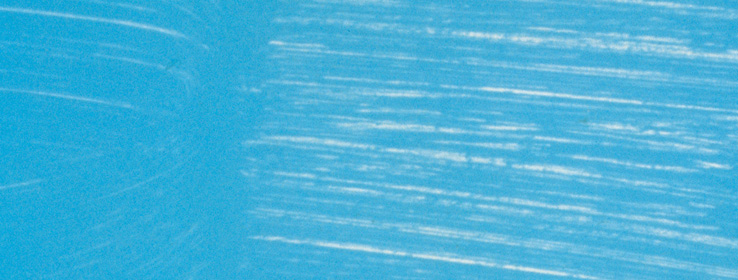
DESCRIPTION
Failure of dried paint to obscure or hide (e.g. ability to fully conceal painted surface) the underlying color or surface to which it is applied.
POSSIBLE CAUSE
Applying too thin of a paint film.
Use of paint with low hiding characteristics.
Use of a paint that is much lighter or darker than the previous coat.
Use of the wrong type or nap size of roller cover. Use of the wrong type or size of brush.
Painting over a porous surface that absorbs the coating.
Poor flow and leveling.
Thinning/reducing the coating.
SOLUTION
Follow label and data page directions for the appropriate film build (e.g. thickness of each coating layer).
Prime the surface with the appropriate Sherwin-Williams Color Prime® system of gray-shaded primers for the color of the topcoat.
Determine the correct roller cover type or nap based on the coating being applied and the surface to be coated. On smooth surfaces, a mohair, 1/4", or 3/8" roller nap is usually sufficient. On textured surfaces, a 3/4" nap or greater is needed.
Prime porous surfaces before topcoating.
Allow proper drying time before recoating.
INTERIOR
PRIMER
(if needed)
Premium Wall & Wood Primer
Multi-Purpose Interior Oil-Based/Undercoater
Loxon® Concrete & Masonry Primer/Sealer
SUGGESTED FINISH
Duration Home®
Cashmere®
SuperPaint®
ProClassic®
or reapply the same coating
EXTERIOR
PRIMER
(if needed)
Exterior Latex Wood Primer
Loxon® Concrete & Masonry Primer/Sealer
All Surface Enamel Primer
SUGGESTED FINISH
Duration®
ConFlex XL™
or reapply the same coating


