

Close



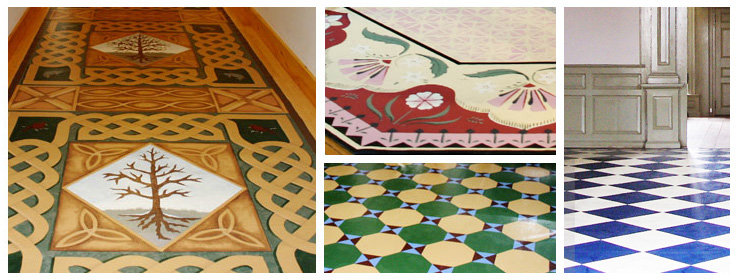

Lisa Curry Mair's decorative floorcloths beautifully merge function, history and bold design.
With a college degree in math and a minor in art, Lisa Curry Mair sought a career that would combine the two seemingly disparate subjects. She studied architecture for a while, but wanted to focus on an "accessible craft rather than an entire house," says Mair.
Mair just wasn't sure what that craft would be, until she stumbled upon it during a trip to Vermont. "I saw somebody doing floorcloths, and I didn't even know what they were at the time," she recalls. "The idea of doing something functional that was also artistic just spoke to me."
Sixteen years ago, Mair formed Canvasworks Floorcloths to craft these decorative – and utilitarian – floor covers out of her home studio in Perkinsville, Vt. History plays a big role in Mair's painted floorcloths, which were the primary choice of floor covering in American homes before linoleum came along in the late 1800s. "Floorcloths were traditionally made of canvas, and that's what I use because I am a stickler for details," says Mair, who employs one part-time worker in her shop.
Some of Mair's customers have initially balked at the idea of a fabric-based floorcloth, thinking they're not going to hold up under wear and tear. On the contrary: The heavy-weave canvas has the thickness of three layers of denim and despite its coatings, maintains the look of fabric when it's completed. "Canvas gives you durability and flexibility," she notes. "The floorcloths do not look like they were made in the 21st century."
Mair takes equal care in presenting a historic theme in her designs, created through freehand sketches, CAD software and Adobe Photoshop and Illustrator. "I like to base my work on something from historical references," she says, "and often that is just a geometric pattern used for floorcloths or inlay floors in the past." Additionally, Mair often incorporates nature-inspired motifs with flowers or leaves to work with the base geometric design.
Sherwin-Williams to the Rescue
During the last decade and a half, Mair's business has flourished. Up until three years ago, she had received very few complaints about her floorcloths; they were withstanding the test of time and looked as good as they day she created them. However, in the span of one year, three big pieces were returned to Mair because the paint started to crack.
"Moisture and dirt can get down into those cracks, and then the paint lifts off the canvas," she explains. "I offered to replace the floorcloths, but these people were so upset, they just wanted their money back. Then I started wondering, 'How many of these are going to come back?' It was a really scary time."
The cracked floorcloths prompted Mair to reevaluate which paint and finishing products were the best for her business. "I had been using different brand names," she admits, "and I was buying whatever paint and other discount items I could find at the hardware store."
Mair's research led her to her local Sherwin-Williams store, where employees reviewed her problems and looked for solutions companywide. After five months of trying different Sherwin-Williams products, Mair settled on the company's DTM marine-grade acrylics "for everything from primers right up to my clear finishing coats," she notes. (To test the tenacity of the new materials, Mair threw a sample piece of a finished floorcloth into a snow bank and drove over it. The result: absolutely no damage.) Since using the acrylics, Mair has received nothing but positive feedback. Her historic floorcloth recreations are on display at museums throughout the country, including the Museum of Fine Arts in Boston and Mount Vernon Hotel Museum in New York City. Mair's installation at Rosedown Plantation in St. Francisville, La., serves as a testimonial to the longevity of her floor coverings made with Sherwin-Williams products. "They get 30,000 people every year walking directly on these pieces, and the museum says they look as good as new."
Most of Mair's business is residential, where floorcloths average 6 feet by 8 feet. Eat-in kitchens and dining rooms are popular places for the pieces. They're easily cleaned with a damp mop – they can be treated like a vinyl floor while maintaining their matte fabric look. "And if you spill anything like spaghetti sauce or red wine, it won't stain. It will just wipe right up," Mair says.
In spite of the easy care routine, some customers prefer to use the floorcloths as wall hangings instead, telling Mair that they're "too pretty to walk on." Homeowners also hire Mair to create large murals on canvas instead of having them painted directly on the walls. That enables the occupants to take the custom artwork with them if they move. Mair's future plans include branching out into the hospitality market. As she puts it, "Hotels would be the perfect place to use floorcloths because they're really durable, and you can customize the design to whatever message the hotel is trying to convey."
What's more, Mair passes along her knowledge of floorcloths by teaching a variety of classes she offers online, in her studio and off-site. "I always tell my students to use Sherwin-Williams because I don't want them to put all that hard work into painting this beautiful piece and have it crack and fall apart. I have been there, and it is such heartbreak. Sherwin-Williams saved my business."


